


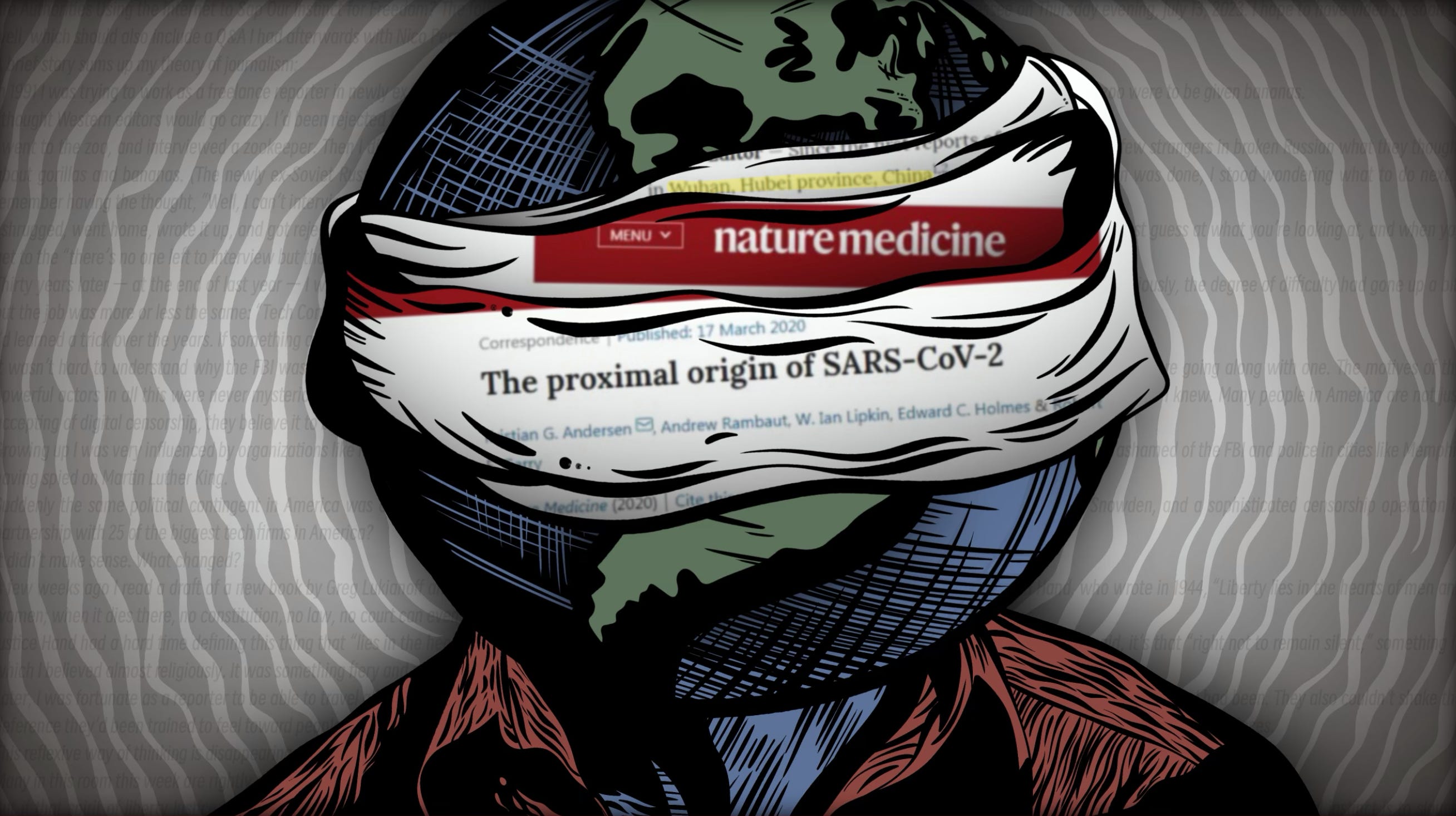
On February 5th, 2020, as a small group of scientists were crafting a Nature magazine paper that would become the basis of years of reports insisting Covid-19 had natural origins, one of the co-authors, Tulane’s Dr. Robert Garry, wrote in group email:
Accidental release is a scenario many will not be comfortable with, but cannot be dismissed out of hand.
As detailed in an explosive Public story today, Garry’s thinking changed suddenly when then-New York Times reporter Donald McNeil asked the next day: “Is there any possibility that it could be from the Wuhan lab?”

Garry warned McNeil was “credible,” but “like any reporter can be mislead [sic],” cheering colleague Dr. Andrew Rambaut’s scientific version of a non-denial denial as a “good honest response.”
Last week, House members investigating origins of Covid-19 accidentally released a trove of Slack chats and emails between the authors of Nature’s seminal paper from March 17, 2020, The Proximal Origin of SARS-CoV-2. The Proximal Origin paper delivered a single line that for years helped authorities slam a lid on theories of human intervention in Covid-19: “It is improbable that SARS-CoV-2 emerged through laboratory manipulation.”
Chats showing Proximal Origins authors saying things like “The truth will never come out (if lab escape is the truth)” were published first by independent researcher Francisco Del Asis of the independent investigatory group DRASTIC, after which the story was picked up by Ryan Grim of The Intercept. From there, health officials did their best to ignore the material — “Many of them remained silent with this revelation,” is how De Asis puts it — almost as if they were waiting for another shoe to drop.
That other shoe is dropping. Public and Racket last week obtained a full complement of the “Proximal Origins” communications examined by the House Select Subcommittee on the Coronavirus Pandemic, revealing a story far worse than previously believed. While today’s Public story details the unprecedented scientific cover-up, the letters and chats examined here at Racket show how health officials and scientists constructed perhaps the most impactful media deception of modern times, exceeding even the WMD fiasco both in scale and brazen intentionality. Because House investigators uncovered such a wealth of material, some of the Proximal Origin communications — which shed light on other Covid-related controversies — will be addressed in a second part of this series later this week. For now, however, the degree to which these communications blow up years of news stories stands out.
The released communications mainly center around four of the five Proximal Origin authors: the aforementioned Dr. Rambaut of the University of Edinburgh, Tulane’s Dr. Garry, Scripps Research Professor Dr. Kristian Andersen, and University of Sydney Virologist Edward “Eddie” Holmes. There are also email communications with the fifth author, Columbia’s Dr. Ian Lipkin, who is not on the Slack chats but does figure in the story.
The core four on the Slack chat — Andersen, Garry, Rambaut, and Holmes — never appear far from thoughts about the Wuhan Institute of Virology (WIV) and famed scientist Shi Zhengli. Affectionately dubbed “Bat Woman” by Chinese colleagues, Shi received grants to research bat viruses, including a recent one called “Understanding the Risk of Bat Coronavirus Emergence” in which she partnered with Peter Daszak of the U.S-based EcoHealth Alliance on so-called gain-of-function experimentation.
At one point, Andersen complains about containment procedures at the WIV, noting, as biosafety expert James Le Duc would write in an email later that year, that the facility was conducting very dangerous experiments as Biosafety Level 3 (BSL-3), while the higher BSL-4 would normally be considered necessary. “I’m all for GOF experiments, I think they're really important,” Andersen writes. “However performing these in BSL-3 (or less) is just completely nuts!”
Andersen goes on to say he’s “evolved” on the question of gain-of-function research, saying he’s not sure if such knowledge is “actionable,” while “of course being exceptionally dangerous. It only takes one mistake.”

It later came out that WIV was performing some of its experiments at an even lower level. “Keep in mind that WIV actually performed a lot of their coronavirus work at BSL2, which is what ultimately prompted Ian Lipkin to change his mind,” says DRASTIC founder, referring to comments by Lipkin to McNeil in May of 2021, saying “My view has changed.”
The core four also repeatedly pored over the problem posed by the “furin cleavage site,” a distinctive feature of the Covid-19 genetic sequence. As is now known to the general public thanks again to the digging of the DRASTIC group, which leaked the material in the fall of 2021, researchers at the University of North Carolina led by Dr. Ralph Baric had sent a proposal to the Pentagon seeking to introduce “human-specific cleavage sites” into bat coronaviruses, for a program called DEFUSE. Baric and Shi had worked together on more than one occasion, and even co-authored a paper in 2015 demonstrating that a coronavirus spike protein can infect human cells.
In any case, with these and other issues in mind, all five scientists express belief that escape from the Wuhan lab was at least possible, if not probable:
Andersen: “The lab escape version of this is so friggin’ likely because they were already doing this work…
Garry: “The major hangup I have is the polybasic cleavahe [sic] site… it’s not really a natural process.” Also: “It’s not crackpot to suggest this could have happened given the GoF research we know is happening.”
Lipkin: “[A draft of the paper] does not eliminate the possibility of inadvertent release following adaptation through selection in culture at the institute in Wuhan. Given the scale of the bat CoV research pursued there… we have a nightmare of circumstantial evidence to assess.”
Holmes (replying to Lipkin): “I agree… Seems to have been pre-adapted for human spread since the get go. It’s the epidemiology that I find most worrying.”
Rambaut: “I am quite convinced it has been put there by evolution (whether natural selection or artificial).”
The community of scientists who work on the specific area of “pathogen spillover” and gain-of-function is “tiny,” says one researcher from that world, who asked to remain anonymous. Within that insular group, the characteristics of the Wuhan outbreak and the virus’s genetic sequence — while not offering definitive proof of human intervention — conjured obvious and immediate concerns, as Andersen’s “so friggin likely” remarks show.
“I can just tell you,” says the researcher, who has experience working with bat viruses, “that if someone proposes to insert a furin cleavage site in a bat SARS coronavirus in Wuhan, and then one year later we see a bat SARS coronavirus with a furin cleavage site in Wuhan, that is highly unlikely to be a natural event.”
In addition to referencing “GOF” work, the researchers also repeatedly referenced concern over the political consequences of publicly suggesting any kind of human intervention caused the outbreak, even if that happened to be the truth. “Destroy the world based on sequence data. Yay or Nay?” asked Andersen:
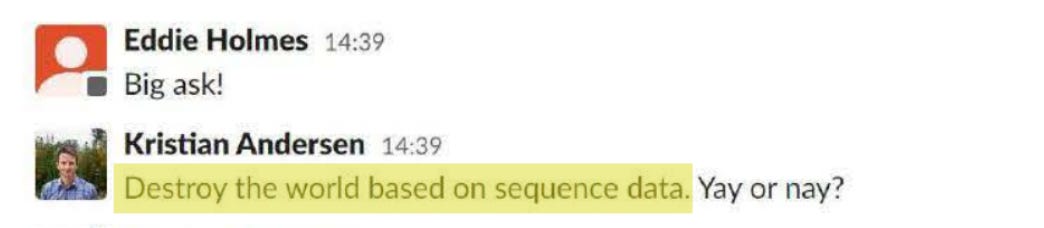
Rambaut cited an erroneous analysis from the past. “Remember when during the swine flu outbreak Adrian Gibbs suggested it was a lab escape? Caused a huge shit show.” Garry concurred, saying, “The public space is not the place to discuss this, which WHO should be aware of [realizing that in itself will pour gas on the fire].” Later, Andersen added: “I hate when politics is injected into science — but it’s impossible not to, especially given the circumstances.”

What “circumstances”? Beyond the long history of grants for research involving bats, coronaviruses, and the Wuhan Institute, the unique characteristics of the Covid-19 virus raised suspicions, according to multiple sources.
“I think this was purposeful research to try to make a vector to be used to help vaccinate both military and civilian populations, against a variety of different pathogens,” says then-CDC chief Dr. Bob Redfield, stressing he believes the WIV work was “biodefense, not a bioweapon.” The communications of the Proximal Origin authors, Redfield believes, show the scientists were both conscious of the WIV’s work and flummoxed by the task of explaining the virus’s genetic “anomalies,” but ultimately pressured to ignore both issues by health bureaucrats seeking what Redfield calls a “single narrative.”
As detailed in Public, the Proximal Origin authors who initially discussed lab escape in such a casual manner appeared to have a change of heart after a February 3rd conference call that included the likes of Dr. Anthony Fauci, then-NIH Head Francis Collins, and Dr. Jeremy Farrar of the Wellcome Trust (and now the WHO). Though he was CDC chief at the time, Redfield was excluded. “I should have been invited,” he said, but “I didn’t find out about these phone calls until the Freedom of Information came out,” referencing a FOIA-based report released by Buzzfeed over a year later.
From that point forward, references by scientists to “lab escape” became less frequent, with some of the Proximal Origin authors claiming to be impressed by various developments, including data sets about mutations in pangolins. However, scientists were clearly more moved by internal politics in correspondence with figures like Farrar, who complained questions about pandemic origin had “gathered considerable momentum not in social media, but increasingly among some scientists, in mainstream media, and among politicians.”
Anxious to please, Holmes at one point went as far as to say about a draft of the paper, “Jeremy Farrar and Francis Collins are very happy. Works for me.” This feels significant among other things because Andersen testified that when Republicans claimed the Proximal Origins authors “sent a draft to Drs. Fauci and Collins” and that “prior to final publication… the paper was sent to Dr. Fauci for editing and approval,” Andersen said, “These statements are false.”
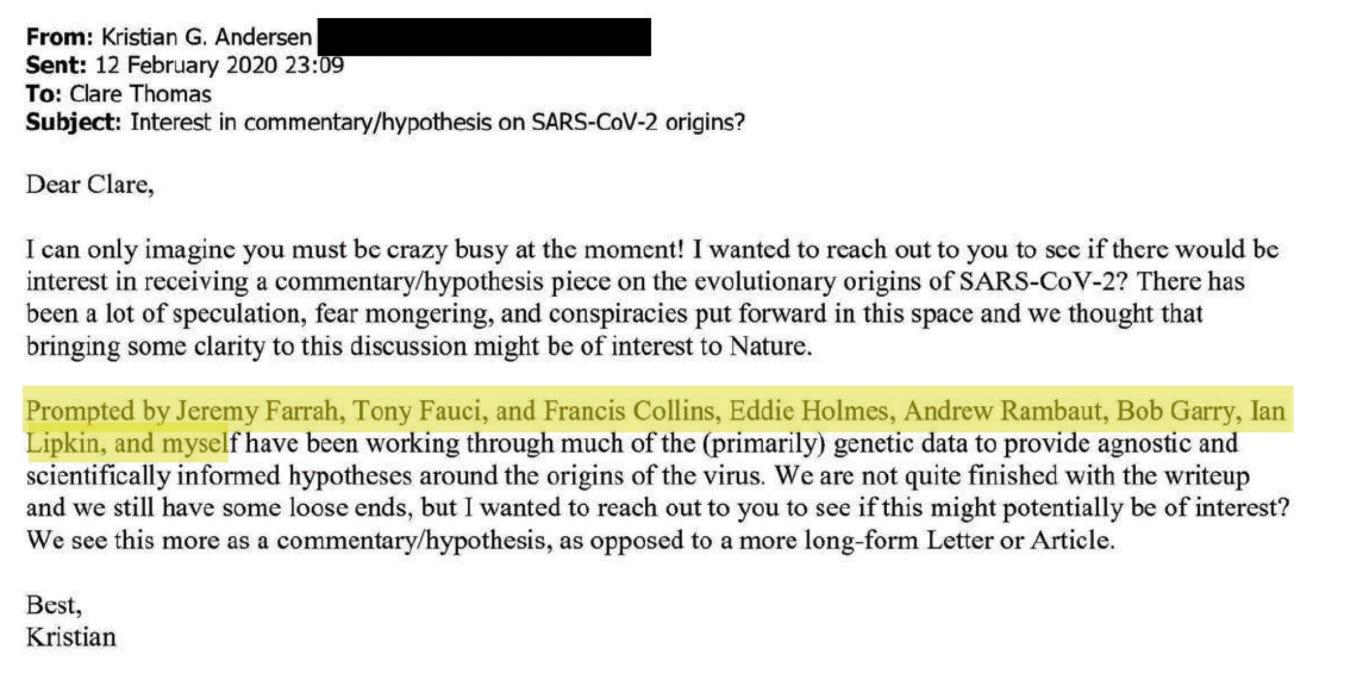
Andersen supported the idea of writing the final Nature draft so as not to leave any room for speculation about lab origin. “I believe that publishing something that is open-ended could backfire at this stage,” he wrote, conceding also at another point that “Our main work over the last couple weeks has been focused on trying to disprove any type of lab theory.” On February 8th, Andersen said, “We should all just stay on Slack, that’s what we should do — and not use email.” In a February 12th letter to Nature virology editor Clare Thomas, he went so far as to describe their proposed paper as having been “prompted by Jeremy Farrar, Tony Fauci, and Francis Collins,” only after which did he list the actual authors:
By February 27, 2020, Andersen told Nature editors the virus “does have natural origin,” and by the next day, Rambaut was referring in Slack to “lab origin conspiracy loons.”

In one key email early in the process, Andersen complained about attention from the press, saying the “idea of engineering and bioweapon is definitely not going away.” While “there might be a time where we need to tackle that more directly,” he said, “I’ll let the likes of Jeremy and Tony figure out how to do that.”

This essentially became the strategy: deflect questions from journalists like McNeil, whittle out of the Nature paper obvious questions about what Andersen and his team originally called the “anomalies” and “circumstances” surrounding Covid-19, and then let “the likes of Jeremy and Tony” handle questions about “lab escape” going forward.
The list of instances in these chats and emails in which the key authorities on Covid’s origins express doubts about theories that would go on to be embraced by officialdom for years is too long to fully catalog here, but for example: the authors seemed unanimous in their assessment that the so-called “wet market” was an unlikely crime scene. “No way the selection could occur in the market,” says Holmes at one point. Garry agrees and says, “Where would you get intense enough transmission… to generate and pass on the furin site insertion?” Rambaut says, “That’s the million dollar question,” and goes on to suggest not “raccoon dogs” or “palm civets,” but ferrets. “I could believe ferrets,” quips Andersen.

It’s with the publication of The Proximal Origin of SARS CoV-2 on March 17th that the unprecedented campaign of media deception really begins. The primary authorities on the question of whether or not the virus was the result of “laboratory manipulation” now turtled, saying little, while other media figures and politicians on a near-constant basis referred to the paper as the authority on the matter, suppressing questions about the pandemic’s origin.
The “lab leak theory” became infamous in mainstream circles among other things because Donald Trump seemed to blame China for the mess, using terms like “Kung Flu,” and secondarily because it appeared to implicate a neoliberal hero, Dr. Anthony Fauci, who stepped into the shoes of Robert Mueller as the favored leading man of the mainstream press. Fauci too had votive candles made with his image, enjoyed Nicolle Wallace gushing she was a “Fauci groupie,” and got to watch SNL do regular “Fauci cold opens,” in which the slight bureaucrat was depicted swatting away bras thrown at him by adoring fans, or being asked by morons if girls can get pregnant in the sky. The attention clearly got to Fauci’s head, because he soon began to write his own satirical material, telling Chuck Todd that attacks on him were “attacks on science”:
But this framing had everything to do with the fact that the two figures most on television during the early days of the pandemic were Trump and Fauci, setting up a fierce culture-war rooting interest in the origin question where it didn’t belong. The provenance of Covid-19 was a legitimate angle for journalistic investigation for many reasons. For one thing, the appearance of that particular virus in that particular city was an extraordinary coincidence (as one source put it, “It’s not like it was the neighboring city”), lab leaks were not uncommon, and the genetic sequence of this virus had characteristics of real research that was conducted by both Chinese and American scientists, research of a type Anthony Fauci had fought for dating back to the Obama years.
An accident with “gain of function” research moreover might have implicated the exact figures taking the lead in denouncing the lab origin theory, including not just Fauci but figures like Daszak of EcoHealth Alliance. It’s remarkable now going back and looking at (of all people) Newt Gingrich interviewing Fauci and Daszak on February 9, 2020, in which Gingrich asks Fauci about an “urban legend” that the virus might have come from a lab. Fauci replies that it’s a “conspiracy theory… without any scientific basis,” and Daszak agrees that “all the evidence” pointed to the virus crossing from animals to humans in nature or the wet market. As we later found out, this interview aired three days after Daszak prevailed upon UNCs Baric not to sign a joint letter in Lancet denouncing the lab-leak theory, essentially to keep the public off the scent. “We’ll then put it out in a way that doesn’t link it back to our collaboration,” Daszak wrote, with Baric agreeing, “this is a good decision. Otherwise it looks self-serving.”
More to the point, however, the origin of Covid-19 was and is clearly an unsolved mystery. “Lab escape” and the less scary semantic variants of same discussed by the Proximal authors (e.g. “passage”) simply could not be excluded until scientists identified, say, the intermediate animal host that allowed the virus to jump to humans. As long as that question was unresolved, every possibility should have remained on the table. But from the start, authorities coalesced behind natural origin, and engineered a relentless and incredibly effective propaganda campaign to dismiss and even censor these very logical inquiries, with the Nature article at the center.
“I read Proximal Origin first, and immediately the reaction was that it felt like propaganda,” says researcher. “The arguments structured were just so far out of the norm of the standards of evidence… Typically when we’re like, ‘Oh, Where does the virus come from?’ the answer is, ‘I don’t know.’ But here they knew.’”
The first major coverage development after the March 17, 2020 publication was subtle. While the Nature team merely said they found no evidence of lab escape, headlines soon flowed suggesting something far more affirmative. “COVID-19 coronavirus epidemic has a natural origin,” declared Science Daily, the same day Proximal Origin was published.

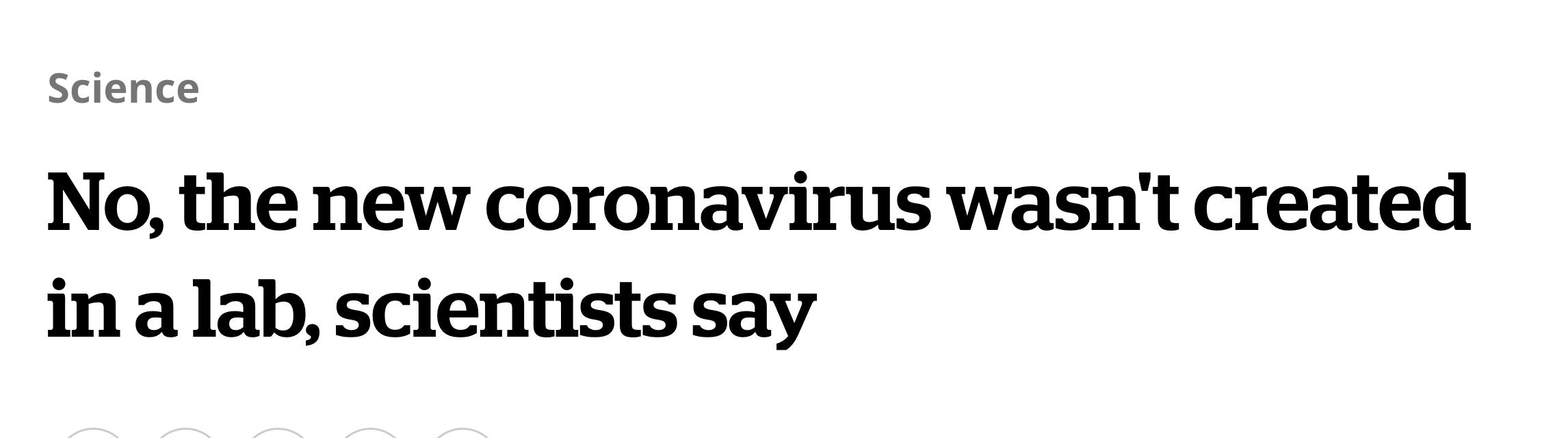
Moreover, while the Proximal Origin authors could only say lab origin was “improbable,” legacy media outlets soon after began using the report to assert something far stronger that the report explicitly didn’t exactly say. “No, the new coronavirus wasn’t created in a lab, scientists say,” announced the CBC on March 26, 2020.
Crucially also, fact-checking authorities like Politifact began denouncing the concept as “conspiracy theory” and rating people who suggested the virus was “man-made” using absolute terms like “false” or “debunked.” It wasn’t until over a year later, as federal agencies like the Department of Energy and the FBI began concluding lab origin was at least possible if not likely, that PolitiFact began to correct itself.
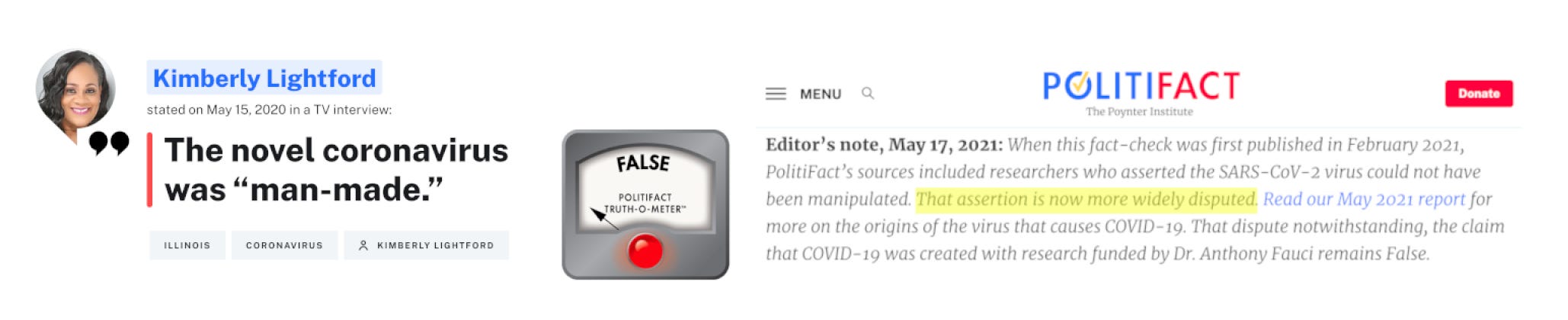
Particularly in 2020, scientists all over the world were rebuked, removed from the Internet, and in some cases fired for spreading the “conspiracy theory” that parts of the Covid-19 genetic sequence suggested laboratory origin.
For a certain type of grant-dependent intellectual, a message was sent not only by the Nature paper published in March, but by an open letter put out weeks before and signed by 27 prominent scientists in the prominent journal Lancet. The message got even louder when Andersen and Garry were two of seven researchers to receive an $8.9 million grant from Fauci’s National Institute of Allergy and Infectious Diseases (NIAID).
Stanford professor Jay Bhattacharya, who would eventually be deamplified and placed on a “trends blacklist” on Twitter for criticizing lockdowns and other Covid-19 policies, said medical professionals and researchers got the message loud and clear.
”You got Lancet and all these like funders like Jeremy Farrar and Francis Collins saying this question is essentially done,” Bhattacharya says now. “No one was going to speak up.”
Even credentialed scientists began to be disciplined by sites like Facebook, which took direction from government health authorities and prohibited statements about the virus being “man-made or manufactured.” There was also an impact on the press, especially after the popular site Zero Hedge was removed from Twitter after an article suggesting a scientist in Wuhan was behind the outbreak. It later turned out that Farrar referenced the Zero Hedge article in a letter to Fauci not long after the site was suspended.
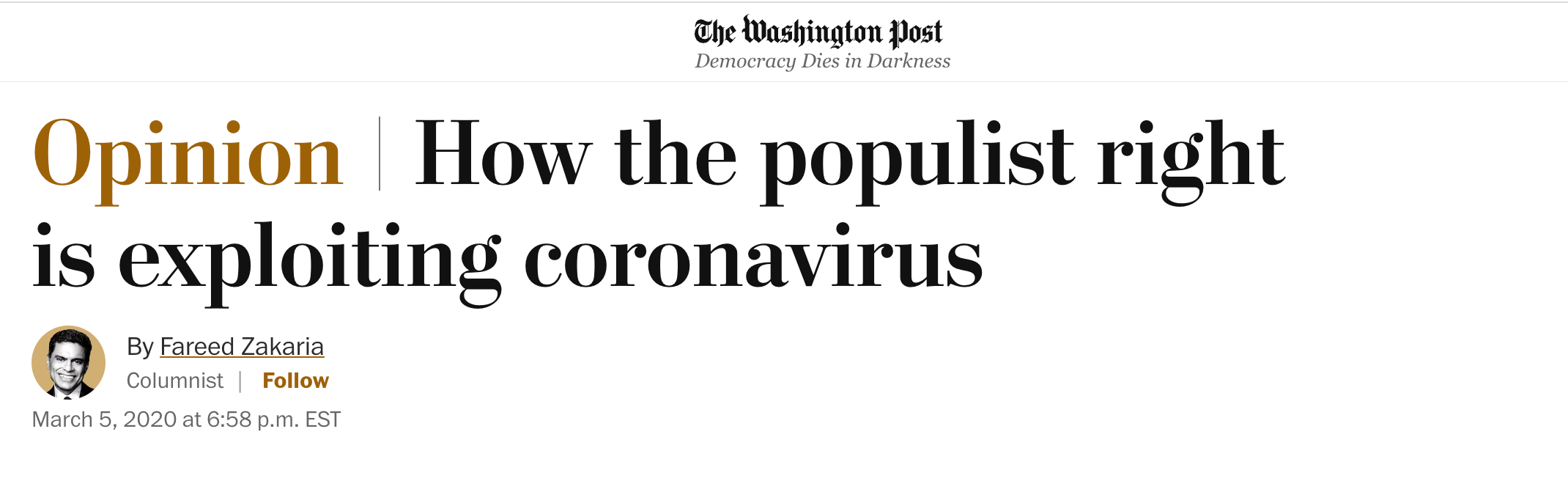
With a few notable exceptions, nearly everyone in the mainstream press community steered clear of any investigation of the possibility of lab origin for Covid-19, for several reasons. One key one was that such theories were coded early on as “right-wing” or even racist. “I was publicly libeled as a racist sinophobe,” says Deigin of DRASTIC, “and of course ridiculed as a crackpot conspiracist by countless virologists and their fanboys.” Prominent figures on channels like MSNBC hammered the idea that “lab leak” was right-wing lunacy, with Nicolle Wallace calling it “one of Trumpworld’s most favorite conspiracy theories,” while Fareed Zakaria in the Washington Post announced, “The far right has now found its own virus conspiracy theory.”
However, in 2021, both the FBI and the Department of Energy issued reports within government that either pointed toward lab escape or allowed it as a strong possibility. The public was not told of these developments, and instead had to watch in confusion as fact-checking authorities and politicians began reversing themselves on this question, with no obvious reason. In May, 2021, Fauci in particular shocked many when he appeared at, of all places, a “fact-checking conference” sponsored by the Poynter Institute, one of the sponsors of Politifact, and suddenly said he was “not convinced” Covid-19 developed naturally:
Now, two years later, we’re finding that the authors of the Proximal Origin paper (all of whom refused comment to Racket and Public, by the way, as did Farrar and Collins) were having many of the same thoughts as academics and pundits dismissed for years as crackpots, racists, and traitors. I asked Deigin if he felt vindicated. “I do somewhat,” he said. “The Slack messages confirm what we long suspected.”
It has to be reiterated that these documents still don’t prove that the virus escaped from the Wuhan Institute, or that American scientists were implicated in the episode. What the documents do show, however, is that both scientists and journalists abandoned their traditional mission to keep their minds open and consider all reasonable evidence without fear of political considerations, in favor of a new discipline that openly admitted political factors and sought a “single message” over free-ranging inquiry. The few mainstream journalists who continued to push this story, like Josh Rogin at the Washington Post, should be commended, but as a whole, both the media business and the scientific profession are taking a big hit after the release of these documents.
“How does the public ever trust science again?” asked Bhattacharya.
Thank you for reminding us all what real journalism and speaking truth to power looks like. A shining beacon compared to our demoralized, shilling, lying corporate media. How do we help others escape the proverbial cave and see the light?
Real journalism, Matt. Not sure what we would be operating on now without the work you and your colleagues are doing.